

Rear Diffusers Explained: Style vs Function
Why Rear Diffusers Are So Widely Misunderstood
Rear diffusers occupy a strange position in automotive modification. They are simultaneously over-marketed and under-explained. Many people install them expecting dramatic performance improvements. Others dismiss them entirely as cosmetic nonsense. Both viewpoints exist because most explanations stop at surface-level descriptions and avoid the uncomfortable middle ground where physics, design limitations, and real-world use collide.
A rear diffuser is not magic. It is not fake. It is a pressure management device governed by strict aerodynamic rules. When those rules are met, it works extremely well. When they are not, their effect shrinks rapidly.
Street cars rarely meet all the conditions that allow a diffuser to reach its full potential. That does not mean the diffuser does nothing. It means its role changes. On the road, diffusers tend to act as stability refiners and airflow organisers, not downforce generators in the racing sense.
What a Rear Diffuser Is in Physical Terms
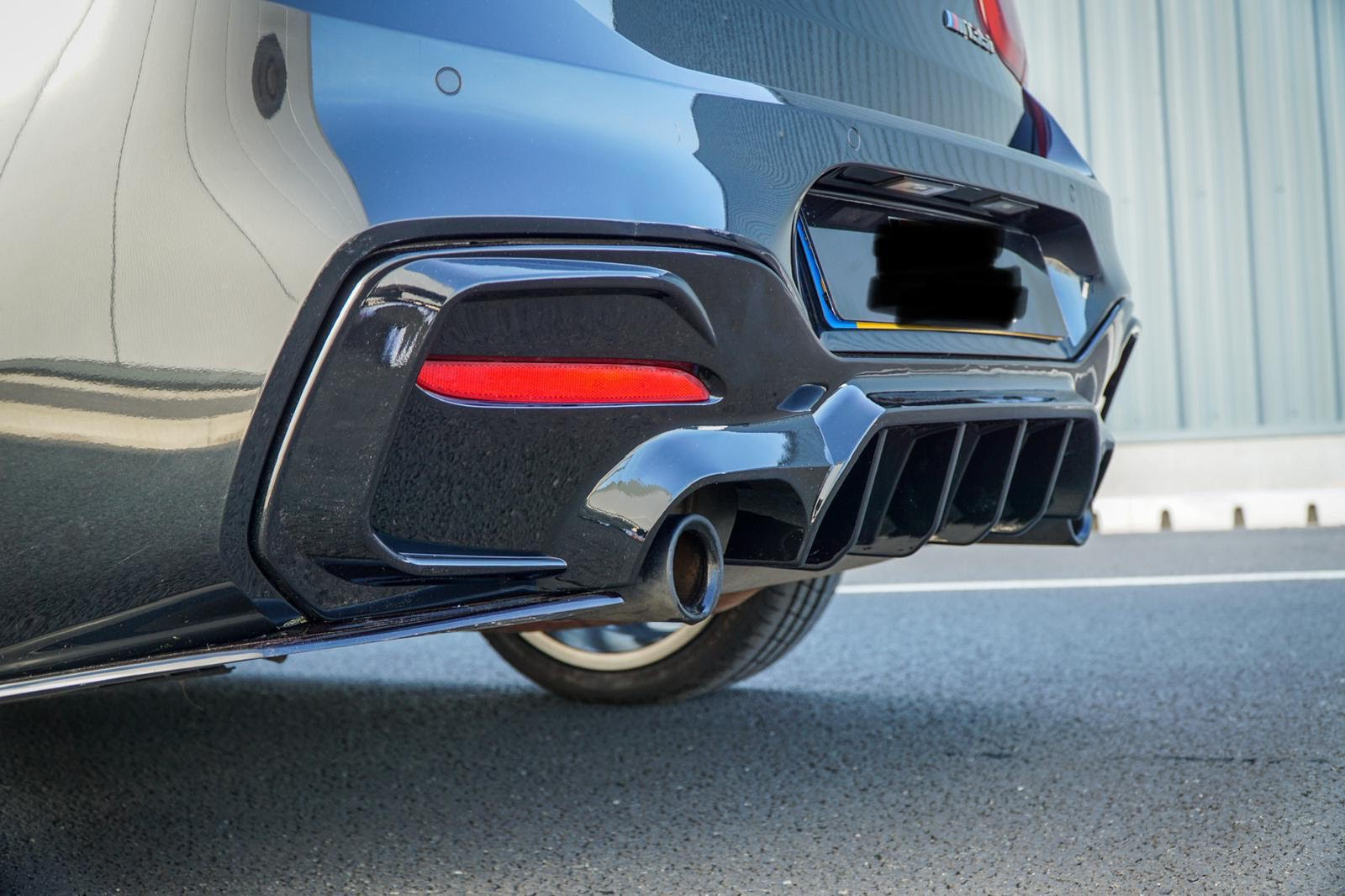
A rear diffuser is an expanding duct placed at the rear underside of a vehicle.
That definition matters because everything a diffuser does follows from it.
Air moving under a car is constrained vertically by the road surface and the chassis. This constraint accelerates airflow. According to fluid dynamics, when airflow accelerates, static pressure drops. Lower pressure under the car compared to ambient pressure above it creates downforce.
The diffuser’s purpose is not to create acceleration. That happens upstream. The diffuser’s job is to control how that accelerated air decelerates and exits.
If underbody air is allowed to exit abruptly:
- Pressure rises suddenly
- Flow separates
- Turbulence increases
- Downforce collapses
- Drag increases
A diffuser prevents this by:
- Expanding the airflow path gradually
- Allowing controlled pressure recovery
- Maintaining attached flow as long as possible
The effectiveness of a diffuser depends on pressure recovery without separation. Once airflow detaches from the diffuser surface, its ability to generate downforce drops sharply.
Pressure Recovery: The Core Concept People Skip
Most explanations of diffusers focus on fins and angles. That misses the real point.
The critical concept is pressure recovery efficiency.
Under the car:
- Air speed is high
- Pressure is low
Behind the car:
- Air speed must slow
- Pressure must rise
The diffuser is the transition zone between these two states.
A well-designed diffuser:
- Slows the air gradually
- Converts kinetic energy back into pressure
- Maintains smooth flow
A poorly designed diffuser:
- Slows air too quickly
- Causes separation
- Generates vortices
- Increases drag
This is why diffuser geometry matters far more than material or appearance.
Why Street Cars Are a Worst-Case Scenario for Diffusers
Street cars create nearly the worst possible conditions for diffuser effectiveness.
Reasons include:
1. Dirty Underbodies
Most road cars have exposed components underneath:
- Exhaust systems
- Rear axles or subframes
- Fuel tanks
- Suspension links
- Heat shields
Each of these disrupts airflow long before it reaches the diffuser.
2. No Edge Sealing
Race cars use skirts, fences, and precise ride height control to prevent air from spilling into low-pressure zones. Streetcars do not.
3. Variable Ride Height
Street suspension moves significantly. Under braking, acceleration, and bumps, the diffuser geometry changes constantly.
4. Low Operating Speeds
Diffusers are speed-dependent devices. Urban speeds are simply too low.
Because of this, street diffusers operate far from their ideal design conditions. They still work, but in a reduced, altered role.
What a Rear Diffuser Actually Does on a Streetcar
On a streetcar, a rear diffuser primarily does three things:
1. Reduces Rear Lift at Speed
Even a compromised diffuser can reduce pressure spikes at the rear, lowering lift on the rear axle at motorway speeds.
2. Stabilises Wake Flow
The diffuser helps organise the chaotic air leaving the underside, shrinking the turbulent wake behind the car.
3. Improves High-Speed Composure
Drivers often report improved straight-line stability and reduced “float” at speed.
What it does not reliably do on the street:
- Generate large downforce values
- Dramatically increase cornering grip
- Transform handling balance
The diffuser acts as an aerodynamic damper, smoothing airflow rather than aggressively manipulating it.
Speed Scaling: Why Diffusers Feel Useless Until They Suddenly Don’t
Aerodynamic forces scale with the square of speed.
This is non-negotiable physics.
If speed doubles:
- Drag increases by four times
- Downforce increases by four times
At 30 mph, aerodynamic forces are negligible.
At 60 mph, they begin to matter.
At 100 mph, they dominate vehicle behaviour.
This explains why:
- Diffusers feel pointless in city driving
- Diffusers feel noticeable on motorways
- Diffusers matter on track
Street cars simply spend very little time in the speed range where diffusers shine.
Is a Rear Diffuser Worth It Without Track Use?
This is not a yes or no question. It is a context question. A diffuser is worth it if:
- You regularly drive at sustained high speeds
- You value stability over outright grip
- You understand the limitations
- You view it as refinement, not transformation
It is not worth it if:
- You expect dramatic handling changes
- You primarily drive in urban conditions
- You believe it replaces mechanical upgrades
Many people are disappointed by diffusers because they expect them to behave like tyres or suspension components. They do not.
Fuel Efficiency: Why the Gains Exist but Rarely Matter
A diffuser can reduce drag by shrinking the turbulent wake behind the vehicle.
In CFD models, this appears as:
- Slight drag coefficient reduction
- Smoother pressure gradients
- Cleaner separation points
In real driving:
- Wind direction overwhelms gains
- Traffic variation dominates
- Driver throttle input masks effects
Fuel efficiency improvements exist, but they are small, inconsistent, and secondary.
No diffuser should be purchased for fuel savings.
Does a Rear Diffuser Make a Car Faster?
In straight-line acceleration, no.
Acceleration depends on:
- Engine torque
- Vehicle mass
- Traction
- Gear ratios
A diffuser does not change these.
Where it can influence performance:
- High-speed cornering stability
- Rear tyre load consistency
- Confidence under sustained load
On track, this can translate into lap time improvement. On the road, it translates into feel, not stopwatch numbers.
Diffuser Geometry: Angle, Length, and Expansion Ratio
Diffuser performance is governed by geometry, not material.
Expansion Angle
If the angle is too shallow:
- Pressure recovery is weak
- Diffuser must be long
If the angle is too steep:
- Flow separates
- Downforce collapses
- Drag increases
For streetcars without sealing:
- Effective angles are conservative
- Below ~7 degrees is safe
- Beyond that, risk increases rapidly
Race cars exceed this because they control airflow aggressively. Streetcars cannot.
Flat Underbodies: Why the Diffuser Is Only Half a System
A rear diffuser cannot be evaluated in isolation. Its effectiveness is inseparable from the quality of airflow feeding it. That airflow is shaped almost entirely by the underbody.
A flat underbody serves three critical aerodynamic purposes:
- It reduces turbulence
- It preserves airflow velocity
- It stabilises pressure gradients
Without a flat underbody, airflow reaching the diffuser is already disorganised. Velocity varies laterally and vertically. Pressure pockets form around components. By the time the air reaches the diffuser inlet, it no longer resembles the ideal flow assumed during diffuser design.
This is why, in controlled testing, a flat underbody often produces more aerodynamic benefit than a diffuser alone.
On many production cars:
- Adding a diffuser without flattening the underbody yields modest gains
- Flattening the underbody without a diffuser yields surprisingly large gains
- Combining both yields the best result
The diffuser amplifies whatever quality of airflow it receives. If the input is turbulent, the output cannot be clean.
This is also why factory performance cars integrate:
- Undertrays
- Rear diffusers
- Exhaust routing designed to minimise disruption
Aftermarket diffusers installed on unmodified underbodies are therefore operating at a disadvantage from the start.
Tyre Squirt: The Hidden Enemy of Diffuser Performance
One of the least discussed but most important factors limiting diffuser effectiveness is tyre squirt.
Rear tyres rotate at high speed and act like centrifugal pumps. They eject high-pressure air laterally outward and upward. This air originates from the contact patch region, where pressure is already elevated.
When this high-pressure air enters the diffuser inlet:
- It raises local pressure
- It disrupts pressure gradients
- It collapses suction zones
- It encourages flow separation
This contamination significantly reduces diffuser efficiency.
On race cars, engineers fight tyre squirt aggressively using:
- Side fences
- Vertical strakes
- Floor edge sealing
- Controlled vortex generation
On streetcars, none of these tools is fully available.
As a result, most street diffusers lose a significant portion of potential effectiveness due to tyre squirt alone.
Vertical Strakes: What They Actually Do (and Don’t Do)
Vertical strakes are often misunderstood as downforce generators. They are not.
Their purpose is flow partitioning.
Strakes divide the diffuser into channels. This does three things:
- It isolates the central diffuser channel from lateral contamination
- It limits pressure equalisation across the diffuser width
- It generates stabilising vortices that act as virtual walls
These vortices help seal the diffuser flow, preventing high-pressure air from rushing into low-pressure regions.
What strakes do not do:
- Create downforce by themselves
- Compensate for poor underbody airflow
- Fix overly aggressive diffuser angles
Strakes protect diffuser performance. They do not create it.
On street cars, strakes help maintain consistency rather than increase peak performance.
Rear Wing and Diffuser Interaction: Coupled Aerodynamic Systems
A rear wing and a diffuser should never be evaluated separately.
They form a coupled pressure system.
A rear wing works by:
- Accelerating airflow over its upper surface
- Creating a low-pressure region above the wing
- Producing downforce via pressure differential
When a wing is placed near the diffuser exit:
- The low-pressure region above the wing reduces pressure at the diffuser outlet
- This increases mass flow through the diffuser
- The diffuser produces more suction under the car
This interaction:
- Increases total downforce
- Improves efficiency
- Reduces drag penalty per unit of downforce
This is why race cars:
- Use wings and diffusers together
- Tune them as a system
- Rarely run one without the other
On streetcars, this interaction exists but is weakened by:
- Wing height restrictions
- Poor underbody flow
- Legal and aesthetic constraints
Still, a diffuser paired with a well-positioned rear wing performs better than either component alone.
Why Diffuser Angle Is So Critical (and So Often Wrong)
The diffuser angle determines whether the airflow remains attached.
Flow attachment depends on:
- Pressure gradient strength
- Surface smoothness
- Boundary layer energy
If the diffuser expands too quickly:
- Pressure rises sharply
- The boundary layer loses energy
- Flow separates from the surface
Once separation occurs:
- Downforce drops sharply
- Drag increases
- Performance becomes unpredictable
For unsealed street underbodies:
- Conservative angles are essential
- Even small increases can cause separation
- Aggressive designs often underperform visually dramatic ones
Many aftermarket diffusers are styled with aggressive angles for appearance. These designs frequently operate in a partially stalled state at speed.
A diffuser that looks extreme often performs worse than a subtle one.
Material Behaviour Under Aerodynamic Load
Material choice affects more than durability. It affects shape retention.
ABS Plastic Under Load
ABS is flexible. Under aerodynamic load:
- It can deflect slightly
- The diffuser angle can change
- Pressure recovery may weaken
On street cars, aerodynamic loads are usually too low for this deflection to matter significantly.
The benefit of ABS is that:
- It absorbs impacts
- It resists cracking
- It tolerates real-world abuse
Carbon Fibre Under Load
Carbon fibre is stiff. Under load:
- Geometry remains consistent
- Designed angles are preserved
- Aerodynamic modelling remains accurate
However:
- Impacts cause brittle failure
- Road debris accelerates wear
- UV exposure degrades resin
Carbon fibre excels when:
- Aerodynamic precision matters
- Loads are predictable
- Maintenance is frequent
ABS excels when:
- Durability matters
- Loads are inconsistent
- Daily use is expected
Neither material is universally superior.
Installation Geometry: Why “Straight” Is Not Enough
Proper diffuser installation is geometric, not cosmetic.
Critical factors include:
- Symmetry
- Longitudinal alignment
- Ground clearance consistency
- Angle accuracy
A diffuser installed:
- One degree off-axis
- Slightly twisted
- Uneven left-to-right
Can:
- Introduce yaw-inducing drag
- Reduce effectiveness
- Increase noise and vibration
Many installation issues blamed on “bad design” are actually geometric misalignment problems.
Fasteners must:
- Clamp evenly
- Prevent movement
- Resist vibration
Tape alone cannot achieve this.
Noise, Vibration, and Harshness: The Overlooked Costs
Diffusers alter airflow. Altered airflow can generate noise.
Common issues include:
- Whistling at speed
- Low-frequency humming
- Rattling from vibration
- Debris striking the diffuser
These issues arise when:
- Edges are not sealed
- Mounting points flex
- Panels resonate at speed
Good installation minimises these effects. Poor installation amplifies them.
Long-Term Ownership Physics
Over time, diffusers experience:
- Thermal cycling
- Vibration fatigue
- UV exposure
- Mechanical impacts
ABS diffusers:
- Fade cosmetically
- Loosen at fasteners
- Rarely crack catastrophically
Carbon fibre diffusers:
- Maintain appearance initially
- Suffer UV degradation
- Crack when impacted
Neither material is maintenance-free.
Periodic inspection is required to prevent:
- Fastener loss
- Panel detachment
- Secondary damage
Cutting the Rear Bumper vs Installing a Diffuser
Removing bumper sections allows underbody air to exit freely.
This can:
- Reduce pressure buildup
- Reduce drag
- Improve stability
However:
- Structural integrity is compromised
- Debris exposure increases
- Legal compliance is affected
- Water intrusion risk rises
Diffusers provide:
- Controlled airflow
- Structural integrity
- Reversibility
- Legal compatibility
They are compromises, not extremes.
Why Diffuser Expectations Fail So Often
Disappointment arises from three misunderstandings:
- Expecting track behaviour on the road
- Ignoring underbody airflow quality
- Treating diffusers as standalone devices
Diffusers are system components. Without the system, performance is limited.
Final Synthesis: Style vs Function, Properly Defined
Rear diffusers are real aerodynamic devices operating under real constraints.
On streetcars:
- They reduce lift modestly
- They stabilise airflo
- They improve high-speed composure
- They dramatically alter appearance
They do not:
- Replace suspension tuning
- Transform grip levels
- Override physics
- Deliver race-car downforce
The function exists. The limits are strict. Style dominates perception because function operates quietly and incrementally. Understanding this distinction is the difference between informed modification and unrealistic expectation.
At KSB AutoStyling, we pride ourselves on being a trusted British manufacturer of durable, precision-fit parts. Whether you are looking for that aggressive look or a bit more stability on the road, we have the expertise to help you get it right. Check out our latest range of rear diffusers to see what fits your build.
FAQs
Q1: Is cutting the rear bumper better than adding a diffuser?
Cutting the bumper (often called a "bumper tuck") is a crude way to reduce the "parachute effect", where air gets trapped in the rear bumper. While it reduces drag, it does not create the controlled expansion and downforce that a real diffuser does.
Q2: How does a diffuser interact with a rear wing?
They actually work together. A rear wing mounted low can help "pump" the air out of the diffuser, making the whole underbody more efficient.
Q3: What happens if I drive without a rear diffuser?
Nothing bad will happen! Your car will just have its factory levels of drag and stability. Most people drive without them every day.
Q4: Is a rear diffuser actually worth it for a daily driver?
Many people on car forums worry that these parts are just for show or "ricey". On a normal street car, the biggest benefit is how it cleans up the messy, turbulent air coming off the rear bumper. It will not turn your car into a race car overnight, but it does help with high-speed stability on the motorway and reduces the "parachute effect" that creates drag.
Q5: Will a rear diffuser block my tow hitch or parking sensors?
This is a huge concern for owners of SUVs and EVs . While some cheap, universal diffusers can interfere with your sensors, model-specific kits are designed to work around them. At KSB Autostyling, our designs align with your factory features, and some even include removable covers so you can still use your tow hitch when you need it.
Q6: Do I really have to take the whole bumper off to install it?
If you want a safe installation that stays on at 70 mph, the answer is usually yes. Taking the bumper off allows you to use proper clips and bolts rather than just relying on adhesive. While it takes more time, it is the only way to ensure the part doesn't become a hazard on the road.
Q7: Can a rear diffuser really help with my fuel mileage?
It sounds like a stretch, but users on Quora and Reddit often report small gains. Because a well-designed diffuser reduces aerodynamic drag, your engine does not have to work quite as hard to push through the air at high speeds. Real-world tests have shown that improving underbody airflow can lead to measurable increases in fuel economy during highway trips.
Q8: How do I fix my carbon fibre if it is turning yellow?
This is caused by UV rays breaking down the resin or the clear coat. If the damage is just on the surface, you can wet-sand the yellowed layer away (stop immediately if the dust turns black!) and then re-spray it with a high-quality, UV-resistant clear coat . To prevent this, many owners recommend applying a ceramic coating to the part as soon as it is installed.
Q9: Should I use 3M tape or Gorilla tape for the install?
Both brands are popular in the car community, specifically 3M VHB and Gorilla Heavy Duty. The most important part of the job is the prep: you must clean the area with isopropyl alcohol and use an adhesion promoter to get a real bond. Even then, we always suggest using mechanical fasteners like screws or bolts for extra security at high speeds .
Q10: What is the difference between a real diffuser and just cutting the bumper?
Cutting holes in your bumper (often called a "bumper cut") is a crude way to stop air from getting trapped inside the bumper and slowing you down . A diffuser is the "proper" way to handle this because it actually shapes and accelerates the air as it exits, creating stability and downforce rather than just letting the air tumble out.